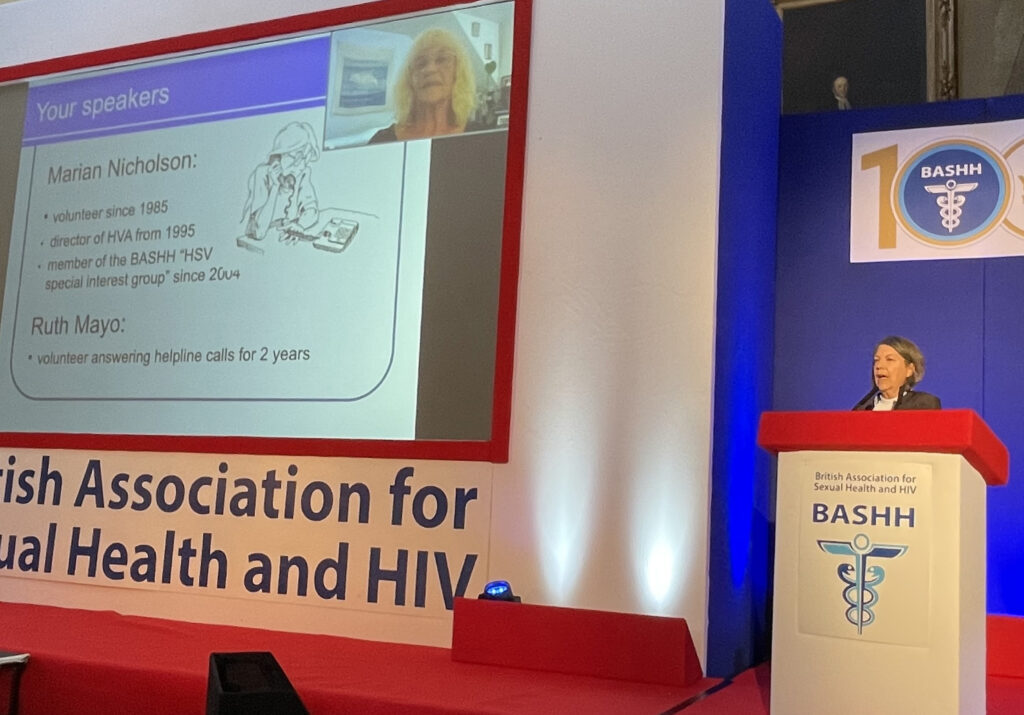
Herpes helpliners were invited to talk to the doctors at the annual conference of the British Association of Sexual Health and HIV in Sheffield in 2022.
A story in the Daily Express on 2nd August 2022 described how a facial infection can reactivate in the eye. This ocular herpes needs to be treated.
“Ocular herpes usually occurs when a previous infection with the virus reactivates and spreads to the eye. Most people will catch the herpes simplex virus as children, but will not notice it as there are often no symptoms.”
For anyone in the twenty first century it is hard to believe that there was a time when ‘herpes’ was not a stigmatised and feared condition. But this is true. Less than forty years ago genital herpes was largely ignored. Newly diagnosed patients were not made to feel that a common skin condition had just ended their chance of having future relationships. Doctors knew that they were simply dealing with the manifestation of the common facial cold sore on a different site and they treated it appropriately. In the early 1980s things changed. How and why did this happen?
Since stupidity, division, snobbery and general unpleasantness continue to thrive among us humans, one might argue that stigma doesn’t need challenging. It fits very well into modern society sitting comfortably somewhere between babyishness and insecurity as a normal human behaviour.
Stigma is primarily defined as ‘A mark of disgrace associated with a particular circumstance, quality, or person’. It does not say if the mark of disgrace in question is in any way justified or rational.
The human condition
- Advertisement -
Perhaps one of the biggest flaws of the human condition is this silly need to separate ourselves from others so as to feel superior. It is something we may all have been guilty of at some point or another. It makes us feel better at the expense of others, and in the purest examples it provides comfort to those with little to feel proud about themselves.
The drop in the number of people who have caught a cold sore in childhood has led to an increase in genital herpes type 1 (and an increase in symptomatic – noticeable – cases of type 2 as well). Yet while few would view a cold sore on the lips as a problem, the exact same sore on the genitals is perceived as distressing by some. This inconsistency makes no sense. And it shines a spotlight on how ridiculous it is to spend even a moment’s thought on herpes simplex, wherever it may be.
- Advertisement -
When my first boyfriend’s cold sore on his lips was passed onto my genitals, it was definitely not the way I had imagined my first month of sexual activity to turn out. Nevertheless, I soon decided it didn’t make any sense to care about this. Even the shocking amount of disinformation and unhelpful pieces of advice I found on the internet did not change my mind. Amid all the nonsense, I also found some important bits of information that helped me dismiss the idea that
As I was creating the media release, I found myself thinking: are the doctors advising Love Island producers so ignorant about herpes that they don’t know that most people with it are unaware of it? (We know that for people with a bad primary infection, or frequent recurrences, that this is a surprise – but it is a fact that: most don’t have anything noticeable.) If we accept that the doctors do know, then perhaps the questions they ask contestants are to protect the producers and not really to find out who has/has not got herpes:
25. Do you currently have a cold sore or genital ulcer?
26. Have you ever had cold sores or genital ulcers or been diagnosed with genital herpes?
- Advertisement -
27. Have you ever taken medication for cold sores or genital ulcers?
By asking these questions, they are performing ‘due diligence.’ The questions will pick up one person in three who has the virus, and who has been diagnosed. But it won’t pick up the two out of three with the virus who get symptoms, but these are too mild to have been diagnosed. So it will not prevent transmission from the people who don’t realise the ‘little thing’ they have on their skin is herpes.
We are getting a lot of calls about herpes medication and the COVID vaccine. (And see lower down for the Covid vaccine and a herpes simplex outbreak.)
Even if I am having herpes symptoms, can I have the vaccine?
Short answer: Yes. You can take herpes medication and the COVID vaccine will be OK.
Longer answer… A herpes simplex outbreak (a ‘cold sore’) is minor problem for the body to deal with. It can certainly manage to control the outbreak and deal with the new ‘flu vaccine’ that is the Covid vaccine. And taking medication to control herpes outbreaks will not affect it. These antivirals do not work on any flu virus at all. (If they did, be sure they would be selling them for treating flu!)
It is generally said that being unwell is meant to be a trigger factor for an outbreak. This is where the names cold sores or fever blisters come from – people noticed they pop out when a person is unwell. Most interestingly we know of people who get a lot of outbreaks but no colds or flu, while people around them are getting these ‘normal’ illnesses.
- Advertisement -
In fact, since having Covid, or flu, could trigger an outbreak, you could say that the vaccine will help with herpes too!
It is perfectly safe. We recommend that people with herpes have the COVID vaccine – or any vaccines offered. Do the best for yourself, get yourself protected against COVID: a serious, life-threatening virus. The vaccines approved for use in UK do not contain egg or any other animal products. Like the antiviral drugs for herpes, all the vaccines are safe for any religious group.
“Having had herpes is not a contraindication for COVID vaccination. As most of the population have been infected with herpes type one or type 2 if there were any complication, we would have seen it by now. There is no scientific basis for thinking there would be any problem. Indeed, I had my first Covid jab yesterday. My past history of oral herpes type one (‘cold sores’) did not concern me.” Professor Colm O’Mahony MD. FRCP. BSc. DipVen.
Because ‘everyone’ has herpes they can have the COVID vaccine.
Well over half the adult population has herpes simplex, though most don’t know it. The NHS wants everyone, regardless of whether or not they get cold sores on face, fingers or genitals to be vaccinated. Take advantage of these medical breakthroughs. They have been subjected to meticulously conducted clinical trials. Such clinical trials are essential to test the safety and effectiveness of experimental treatments and vaccines. (I’ve just received either a vaccine or a salt water injection. I’m taking part in a trial for Novovax.)
After a promising therapy is developed in a lab, it goes through three separate studies to ensure that it won’t cause any serious harm and will be of real medical benefit. Only if it passes all three stages is any new therapy evaluated by a group of independent experts. They assess if it’s safe and effective and can receive a licence for use in the general public. The Novovax vaccine is now on the verge of such approval.
- Advertisement -
Marian is taking part in a COVID vaccine trial
By the time I joined the trial, the study was already in its final ‘phase 3’ research involving over 15,203 volunteers recruited in record time. The participants were divided at random into two equal groups. Researchers made sure the composition of the groups was comparable in terms of age, gender, race and underlying health conditions. One group received the experimental vaccine and the other a placebo. (A dummy therapy, in this case salt water). Rates of side effects and COVID were then compared between the two groups. At the outset, the researchers set strict criteria to ensure that the new treatment really if safe and works. This is so that they couldn’t be accused of moving the goal posts if their study flings up some unexpected or unwelcome findings.
Maria (not our director Marian) sends us “My experience with HSV1” in the hopes it will help people:
I was diagnosed with herpes simplex type 1 on my vulva in early 2012 when I was 23 years old. I had an inflamed lump ‘down below’ and I went to see my local nurse who in turn referred me to a sexual health clinic in London. They reassured me that it did not ‘look like herpes’ and they swabbed the affected area. Ten days later I got a call to say that I had tested positive for herpes simplex type 1.
I immediately thought my life was over despite the girl on the phone being very reassuring telling me that it was “just the cold sore virus.” She sensed my apprehension and invited me in for a chat. Of course, in my frantic state I searched the internet looking for something that could give me more reassurance. There was little to be found other than how to “disclose” to a partner.
- Advertisement -
To this day the word disclose really irritates me. Nobody “discloses” cold sores when they are on the face. I actually ended up in my situation because of a harmless cold sore.
Our patron, Professor Simon Barton, was asked to do a short presentation telling doctors about genital herpes, for a conference in Bucharest. Or really, he was asked to record a short video for the IUSTI virtual conference (about 700 delegates in 46 countries). He invited Marian Nicholson, our director, and Ceri Evans, the senior health adviser from Hammersmith, to join him for this ‘lecture’. He took as the topic: “how we support patients in UK.” (Recording no longer available… Sorry! But we will have something new soon.)
- Advertisement -
Marian must have been saying the right things, as she has been invited to talk again at further conferences, in England and in other nations.